Lifecycle stage Member
No-app wallet and loyalty
Turn one-time customers into regulars, with a loyalty program that lives in their wallet
Most of the revenue you are chasing is already standing at your counter. It is the customer who came in once and could come back, if you gave them a reason and made it effortless to act on. Winning that second visit, and the tenth, is the quiet engine of a healthy business, and it is far cheaper than finding someone new.
The numbers behind this are old but stubborn. Studies widely cited by Bain & Company and Harvard’s Fred Reichheld put the cost of acquiring a new customer at anywhere from 5 to 25 times the cost of keeping one you already have, and suggest that a 5% lift in retention can raise profits by 25% to 95%, depending on the business. Treat those as directional, not gospel. The direction is what matters: keeping customers pays, often more than chasing new ones.
So the real question is not whether retention is worth it. It is why most loyalty programs fail to deliver it, and what actually works.
Why most loyalty programs do not move retention
Two things quietly kill a loyalty program, and neither is the idea of loyalty itself.
The first is friction. A paper punch card gets left in a drawer. A plastic tag clutters a keyring. A branded app asks the customer to go to the app store, download, and create a login, which is a lot to request from someone with a coffee in one hand and a line behind them. People will not install software to save you a stamp, so the program never reaches the people it was meant for.
The second is irrelevance. Even programs that get adopted tend to blast the same message to everyone, ignoring what each customer actually did last. A generic “we miss you” to a regular who came in yesterday is noise, and noise gets tuned out.
Fix both, and retention follows.
Put the program where the customer already is: their wallet
The device your customer never leaves home without already holds a wallet, the one with their debit card and boarding passes. That is where a loyalty program belongs.
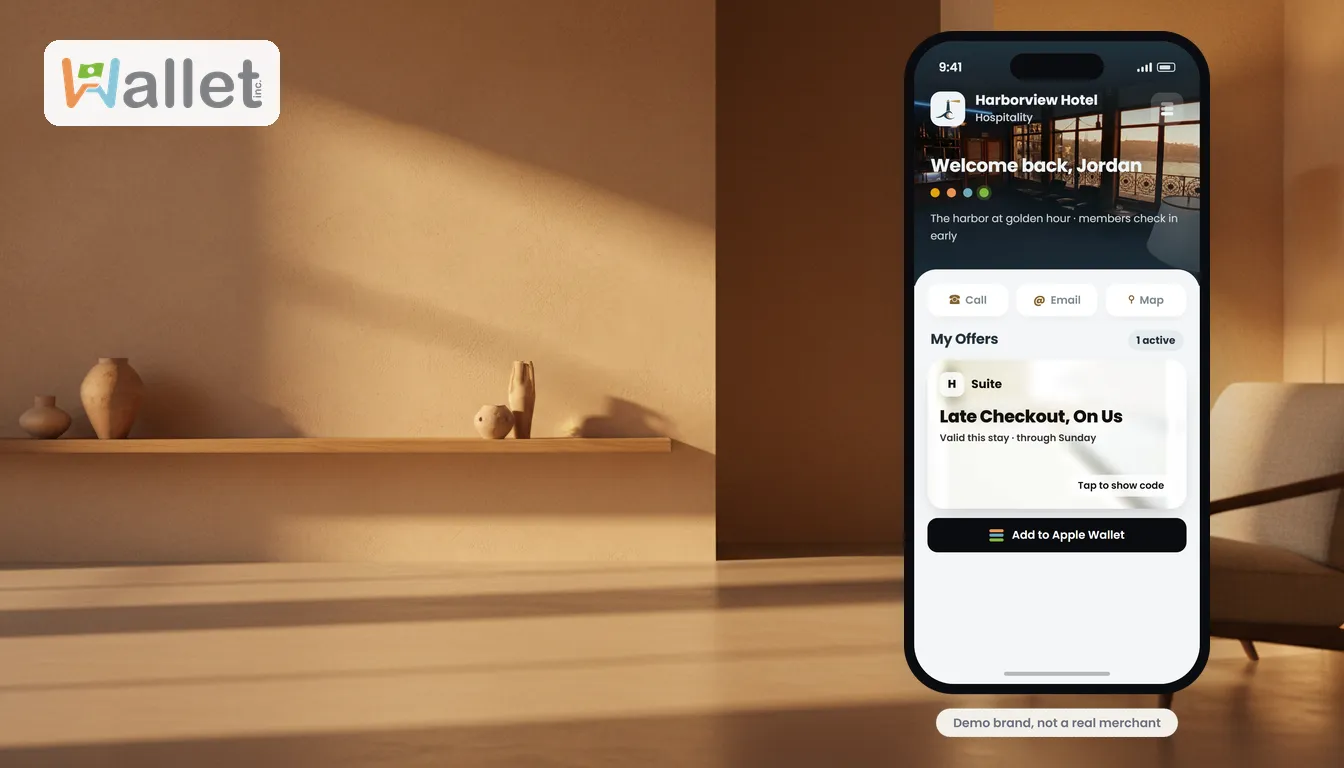
Wallet runs your program as a membership that lives in the customer’s mobile wallet. A customer taps once and gets a single code by text, and from then on their card, points, tier, and next reward are right there, no app to download and no password to remember. It is skinned entirely in your brand, so to the customer it feels like your business simply showed up in the place they keep the things that matter. Because it rides in the wallet they carry, it is never forgotten at home and never buried on a home screen.
This is the heart of the customer lifecycle: the move from Customer to Member, from someone who buys to someone who belongs. Points accrue, a tier unlocks, the next reward stays in view, and each visit has a built-in reason to lead to the next.
The quiet part: why it keeps working after the first visit
Retention only compounds if the program stays alive between visits, and this is where the mechanics matter, briefly.
A wallet pass is not a screenshot buried in a photo roll. It lives in the wallet the customer already carries, so it is always on hand, with no app to reinstall and no card to leave at home. Re-engagement runs on a channel customers actually open: lifecycle-segmented text messages, so the nudge reflects what the customer last did rather than a blanket blast. And all of it sits on the device they already live on. The majority of web traffic has been mobile, not desktop, since around 2017. (Pull the current figure at publish time.) Your customers are already on their phones. The reason to return can be there with them, or it can be a card in a drawer.
It is not just where customers are; it is where retention actually happens. When marketers sort their online channels by job, the ones that drive retention all live on the phone: mobile messaging leads at 58%, then email at 52%, mobile apps at 44%, and push at 39%, while paid search and display skew almost entirely to acquisition. The channel that keeps a customer is the one already in their pocket.
| Mobile messaging (SMS) | 58% |
|---|---|
| 52% | |
| Mobile apps | 44% |
| Push notifications | 39% |
Source: Invesp, Customer Acquisition vs. Retention (eMarketer Cross-Channel Marketing Report)
Where this fits
Acquisition gets you a customer once. Retention is what turns that one purchase into a relationship, and a relationship into the bulk of your revenue. A wallet-based loyalty program is the lowest-friction way to earn the second visit, because it asks almost nothing of the customer (one tap, one code) and keeps giving them a reason to come back.
If you want to see your own brand reskin a wallet and watch a visitor become a member, request a walkthrough. If you would rather just begin, start free and start earning second visits this week.